Whiskey branding and packaging: standing out on the most crowded shelf
Bourbon, rye, Scotch, and world whisky: the finishes, formats, and details that separate a bottle when every label says heritage

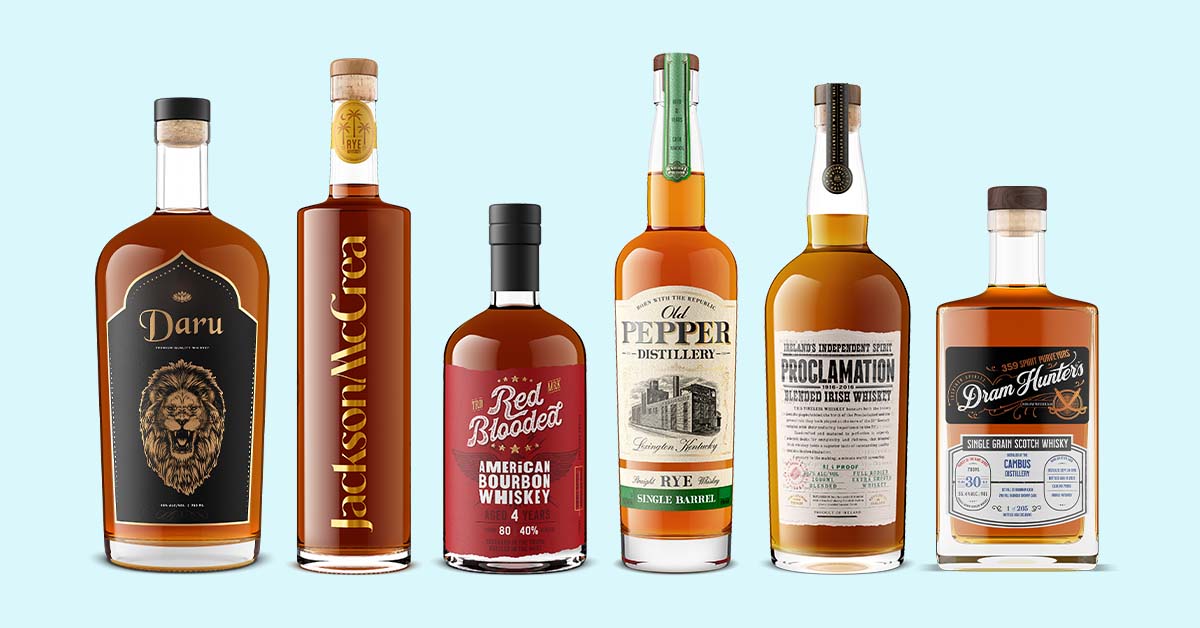
Whiskey is the spirit with the most history to print and the most competitors to print it next to. Bourbon, rye, Scotch, Irish, Japanese, Indian, and now American single malt all share one shelf, and most of them use the same copper foil, the same cream label, and the same word: heritage.
Taken as a family, whiskey has long since surpassed vodka as the largest US spirits category by revenue. The consequence is that a whiskey bottle no longer wins by looking like a whiskey bottle. It wins by being the one a buyer can describe from across the room and find again on a screen.
This guide covers where the category stands in 2026, the packaging decisions that separate a whiskey on a crowded shelf, and how to get the imagery it needs everywhere it sells.
The whiskey market in 2026
The Distilled Spirits Council's 2025 briefing put US whiskey supplier revenue at $11.4 billion across American, Canadian, Scotch, and Irish, down 3.5%, against $7.0 billion for vodka. American whiskey alone was $5.1 billion, down 0.9%, on 30 million nine-liter cases, down 1%, the smallest decline of any major spirits category apart from the growing canned cocktails.
Super-premium American whiskey, over $215 a case at supplier prices, was nearly flat at 0.3% down in volume, while the value tier fell 1.8%. Bourbon's premium buyer is still there. The bargain buyer is leaving.
Scotch had the harder year. The Scotch Whisky Association reported 2025 exports of 5.3 billion pounds, down 1.8%, on the equivalent of 1.34 billion bottles, down 4.3%. Exports to the United States, Scotch's most valuable market, fell 4% in value and 9.2% in volume, and single malt lost 6% of its value worldwide.
The read for a whiskey brand: the category is contracting slowly, the top of the American market is holding, and premium Scotch is the segment under the most pressure. A bottle at $50 to $80 needs a clearer reason than it did three years ago.
Packaging decisions that separate a whiskey
Copper foil is the default, not the differentiator
Metallic copper on a cream label says whiskey in every market. Use it as a base if you want, and put the differentiation somewhere else: the shape, the color, the format, the information.

Print the proof
Age statement, mash bill, cask type and finish, proof, batch or barrel number, the distillery's name if you own it. Whiskey buyers check these before the price, and a label that prints them confidently does what a paragraph of heritage copy cannot.

Finishes matched to the tier
One finish on a $35 bourbon, three on a $120 single malt, and the range reads as honest. Stack four finishes on the entry bottle and the buyer reads a costume.

Own the silhouette, or own the shoulders
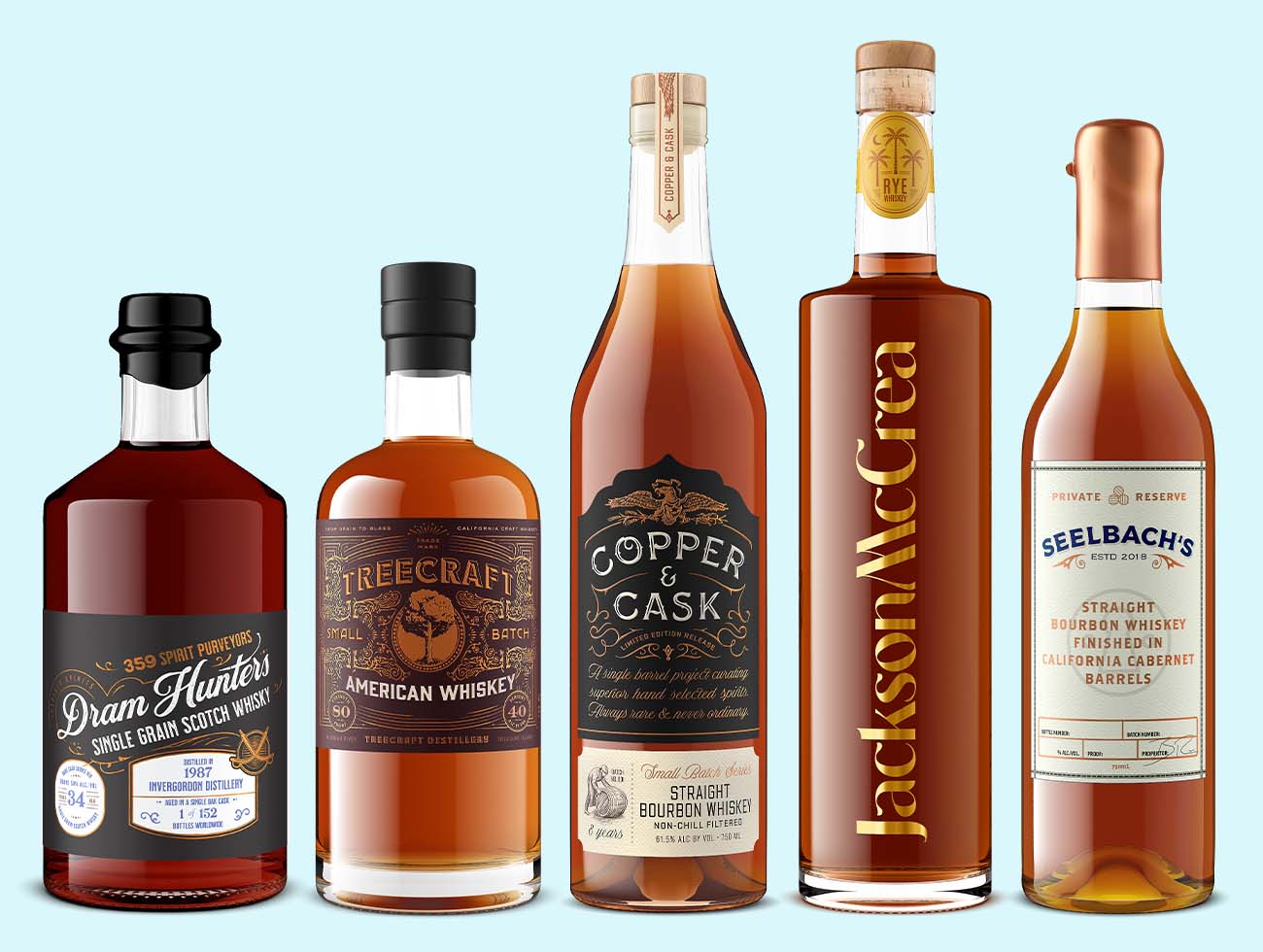
A bespoke mold takes months and a minimum order. Shoulder embossing on a stock bottle takes weeks. Either way, see the shape as a render before the tooling is cut, because a shape that photographs badly is a shape that sells badly online.

Small batch, single barrel, limited edition
Independent distilleries differentiate through cask finishes, barrel strength, and short runs, and the packaging has to carry that variability: a numbered label, a batch line, a seasonal color. A fixed label architecture with one variable panel keeps each release affordable.

Formats that lower the first purchase
700 ml and 750 ml still dominate, but 500 ml bottles carry a higher price per liter and stand out on the shelf, and 50 ml tasting sets reduce the risk of a first purchase. Every format needs its own listing image.

Materials that photograph
Paper-wrapped bottles, silk-screened glass, wood stoppers, and recyclable cartons all signal craft. They are also the hardest things to shoot with a camera, which is worth knowing before choosing them.
Where the bottle gets judged
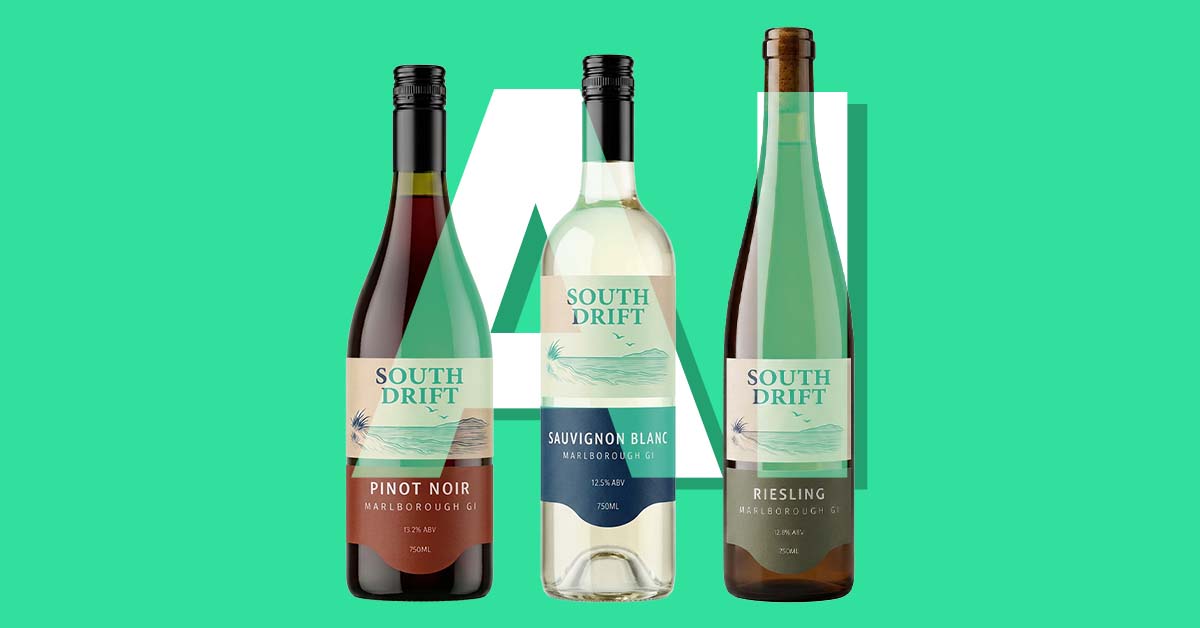
A whiskey buyer in 2026 meets the bottle on a screen first: a retailer's product page, a bar's ordering platform, a distributor's sell sheet, a secondary-market listing, or an AI assistant's shortlist. The copper foil, the emboss, and the age statement have to survive at 300 pixels wide, and the whole range has to sit in a row as one family.
Outshinery Studio builds those images from your label files and bottle specification. A trained 3D artist places the label on a model of your mold, matches the liquid color to the age, and renders the foil, the deboss, and the stopper as they will look in hand, so the image exists before the first run and never needs a reshoot when a batch number changes.
Whiskey is Studio work throughout. Custom molds, embossed glass, wax dips, and gift boxes sit outside what a self-serve tool handles, and spirits product photography covers what a Studio render includes.
The box that hides the bottle
Cartons, tubes, and tins protect the bottle from light and make the gift. They also hide the one thing a shopper recognizes. Print the bottle's identity on the box at the same scale, in the same colors, or the box costs you a sale from a buyer who was looking for the bottle.

The bottle carries the difference
Every whiskey has heritage, and most of them have copper foil. What separates a bottle in 2026 is the proof printed on the label, a finish matched to its price, a silhouette or a detail it owns, and one consistent image of the range everywhere it sells.


Frequently asked questions
Is whiskey still growing?
Not in 2025. The Distilled Spirits Council reports US whiskey family revenue of $11.4 billion, down 3.5%, with American whiskey down 0.9% to $5.1 billion, the smallest decline of any major category apart from canned cocktails. Scotch exports fell 1.8% in value and 4.3% in volume worldwide, with US volume down 9.2%, according to the Scotch Whisky Association. Super-premium American whiskey was nearly flat, so the top of the US market is holding while the entry tier and premium Scotch are under pressure.
What should a whiskey label include?
The style (bourbon, rye, single malt, blended), the age statement or its absence stated honestly, the proof or ABV, the cask type and any finish, the mash bill where it is a point of difference, the batch or barrel number for limited runs, and the distillery. These are the facts a whiskey buyer checks before the price.
What whiskey packaging trends matter in 2026?
Moving past copper foil as the only cue, printing the proof on the front label, finishes matched to price tier, shoulder embossing on stock glass as a faster route to a distinctive bottle, one label architecture with a variable panel for small-batch releases, 500 ml and 50 ml formats, and gift boxes designed to keep the bottle recognizable.
Should a whiskey use a custom bottle or a stock bottle?
A fully bespoke mold owns the silhouette but takes months and a minimum order. A stock mold with custom embossing on the shoulders takes weeks, costs less, and still owns a detail. Both should be seen as a photorealistic render before the tooling is committed, because a shape that photographs badly sells badly online.
How do I get bottle shots for a whiskey without a photoshoot?
Send Outshinery Studio your print-ready label files and the bottle specification. A trained 3D artist builds the render from a model of your mold, including the foil, the emboss, the stopper, and the liquid color for each age, so the image is ready before the bottle exists and stays identical across every retailer listing.
Does Outshinery Lite make whiskey bottle shots?
No. Outshinery Lite is a self-serve generator for wine, cider, and beer in flat-label glass bottles, at $29 an image. It does not cover cans, spirits, or specialty finishes. Whiskey is Studio work.


Keep reading
Whiskey is one lane in a much broader category. For the cross-category view of how distilleries build premium positioning, read how distilleries build premium spirits brands. And for a neighboring category that trades on origin, aging, and heritage cues in much the same way, see rum bottle design and packaging.
The whiskey packaging brief checklist
- Bottle mold: The exact glass mold and manufacturer, with the spec sheet and any shoulder-embossing artwork
- Closure: Bartop cork, stopper material, capsule, and any wax dip or tamper seal
- Label files: The print-ready vector files sent to your printer, front, back, and neck, for every expression
- Print finishes: Copper or gold foil, hot stamp, emboss, deboss, varnish, holographic, called out one by one
- Liquid color: A reference or hex value per age or finish, because a 4-year rye and a 15-year single malt are different ambers in clear glass
- Label copy: Age, proof, cask, batch, and mash bill as they appear on the label, so the render is proofread as well as rendered
- Formats and secondary: Every size you sell, plus the carton or tin if the listing image needs it
- Listing specs: The resolution and background every retailer, distributor, and marketplace requires
One complete brief means the render matches the bottle on the first pass, not the third.