Two datasets, one answer: the bottle shapes beverage brands actually order
Outshinery Studio and Lite order data, side by side: the bottle shapes, sizes and closures brands choose when they order product images.


Bordeaux and Burgundy bottles account for 83% of Outshinery Studio container picks and 86% of Outshinery Lite orders. Two sets of orders that share no tool, no form and no buyer agree on the same two bottles, the same 750 ml size, and cork over screwcap by more than 2 to 1.
Most brands do not describe their bottle by its mold number. They say Burgundy style, or tall with sloping shoulders, and leave the code to the glass supplier.
The choice behind that description is wide. Outshinery Studio's library alone holds more than 1,100 bottle models plus hundreds of closures. Guides to bottle shapes describe what exists; this article counts what brands actually order.
Where the two datasets come from
The data comes from two Outshinery products that work differently and serve different buyers. They are reported side by side and never added together.
- Studio: 2,065 container picks on 2,013 Product Shot requests, logged through June 15, 2026. A trained production team builds each image from the brand's brief, and the client can name any container.
- Studio picks cover more than 360 different bottle and container models.
- Lite: 716 paid orders from 115 accounts, September 4, 2025 to September 2, 2026. The self-serve bottle shot generator offers a fixed library of bottle and closure pairings, so every order is a pick from that menu.
Every rate below is labeled Studio or Lite. A blended total would mix a brief-driven service with a self-serve menu, so there is none.
Method notes 1 and 2, at the end of the article.
Which bottle shapes do brands order most?
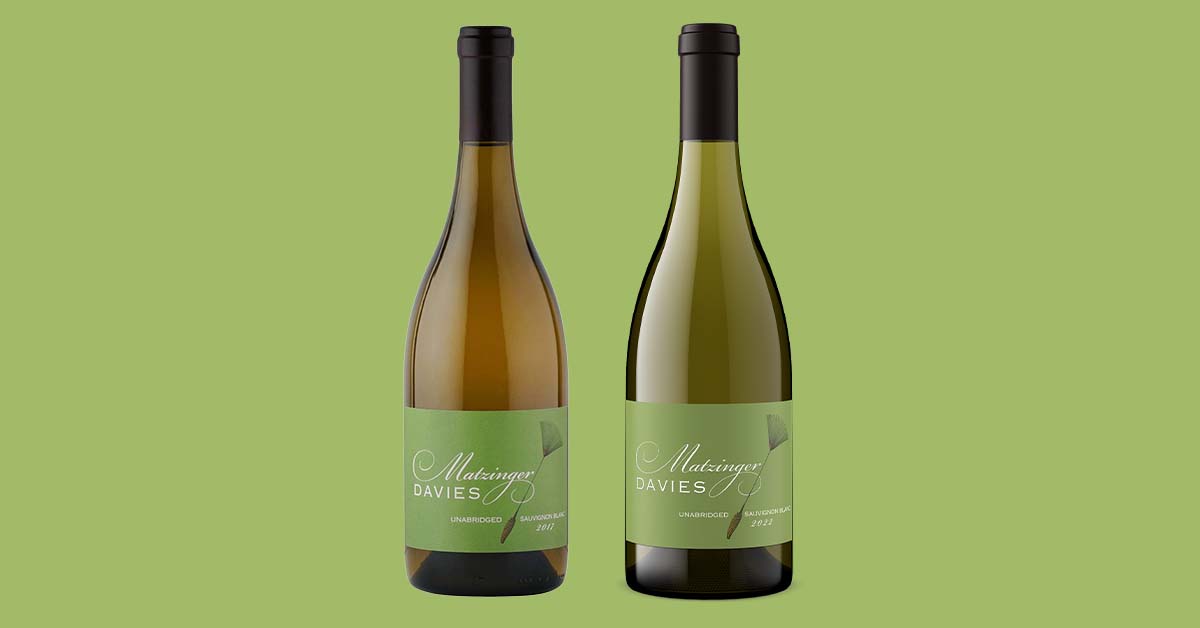
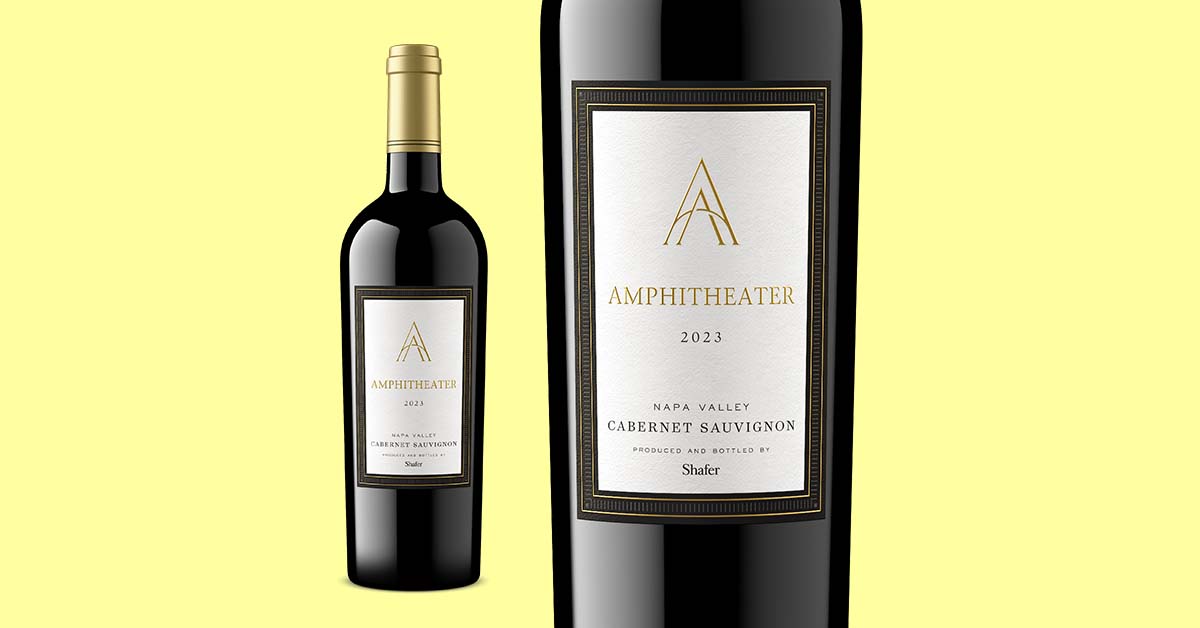
Bordeaux and Burgundy bottles are 83% of Studio container picks and 86% of Lite orders. No other bottle family reaches 10% in either dataset.

The Bordeaux bottle has straight sides and high, square shoulders. The Burgundy bottle is wider, with shoulders that slope into the neck.
The match matters more than either number. Studio clients write a brief and can ask for any of more than 1,100 bottle models. Lite users choose from a menu in a few clicks.
Different tools, different buyers, the same two bottles, more than eight times in ten.
How Studio and Lite compare, family by family
Studio and Lite rank the bottle families in the same order: Bordeaux, then Burgundy, then sparkling, then Hock.

Share of each bottle family
- Bordeaux: 46% of Studio picks, 44% of Lite orders
- Burgundy: 37% Studio, 42% Lite
- Sparkling: 5% Studio, 7% Lite
- Hock, the tall slim bottle used for Riesling: 4% Studio, 6% Lite
- Everything else, cans and spirits bottles included: 9% Studio, under 1% Lite
The one real gap is the long tail. Studio produces images for cans, spirits bottles and specialty glass, so 9% of its picks fall outside the four wine families. Lite offers standard glass bottles only, so its orders stay inside them.
Lite leans slightly further toward Burgundy, 42% against Studio's 37%. That is a lean, not a split.
Method note 3, at the end of the article.
What bottle size do brands order?
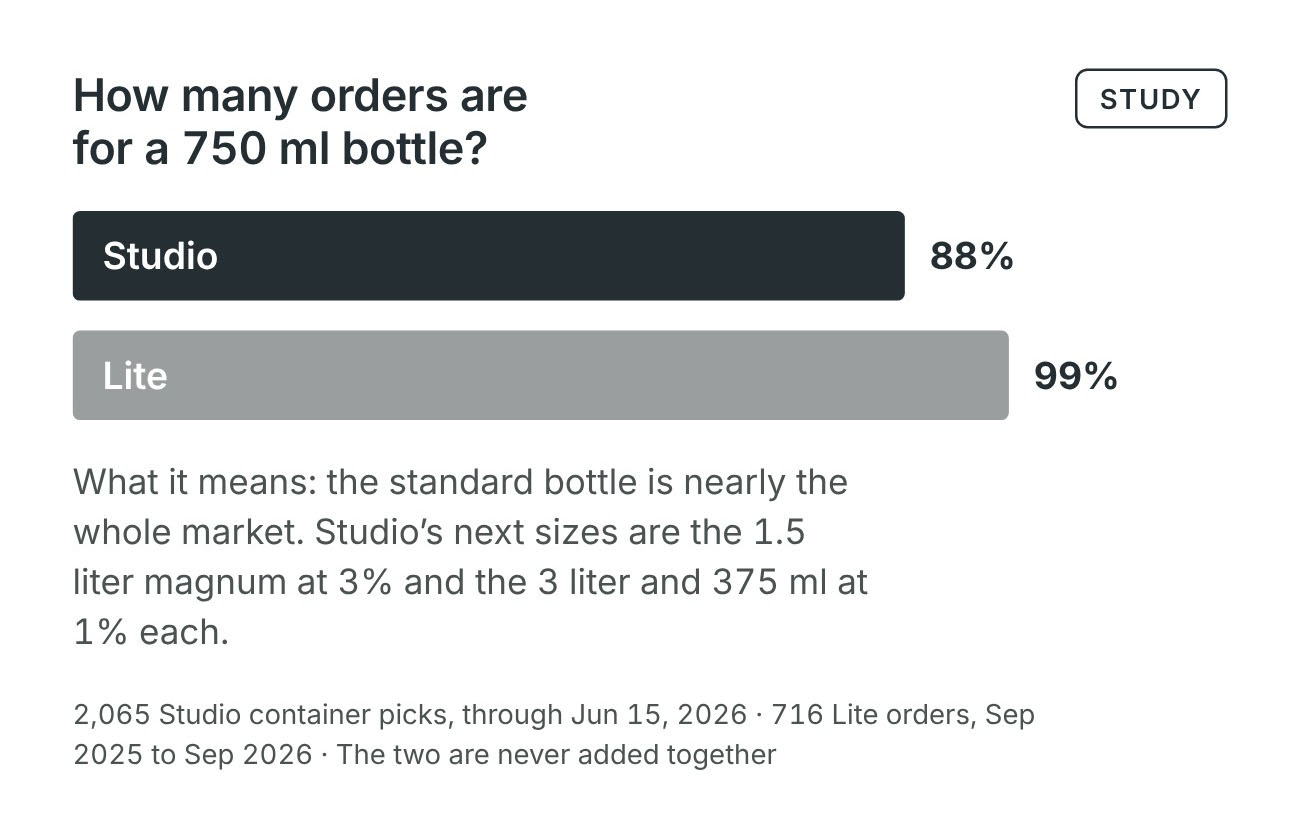
The 750 ml bottle is 88% of Studio container picks and 99% of Lite orders.
The US federal rule on wine container sizes, 27 CFR 4.72, lists 25 authorized standards of fill. Brands use very few of them for the bottle they put in front of a shopper.
In Studio, the next sizes are the 1.5 liter magnum at 3% of picks and the 3 liter and 375 ml half bottle at 1% each. Lite's library is almost entirely 750 ml, so its 99% reflects the menu as much as the choice.
Method note 4, at the end of the article.
Cork or screwcap: which closure brands choose
Cork-based closures outnumber screwcaps by more than 2 to 1 in both datasets: 65% against 29% in Studio, and 70% against 25% in Lite.

Cork-based means any closure with a cork in the neck: a bare cork, a cork under a capsule, a cork under wax, or a sparkling cork with its cage. A capsule hides the cork, but the bottle is still sealed with one.
Closure detail, by product
- Studio: standard cork finish 58%, BVS screwcap 19%, ROPP screwcap 10%, sparkling cork and cage 4%, bar-top cork 2%
- Lite: capsule over cork 35%, bare cork 29%, screwcap 25%, crown cap 4%, wax over cork 4%, sparkling foil hood 2%
The closure story is not Studio against Lite. Cork leads in both, by a similar margin.
For what each closure does to the wine and the shelf, see the guide to wine closures.
Method note 5, at the end of the article.
What Studio data shows about glass weight and shape
In Studio orders, heavy or prestige glass is chosen twice as often as eco or lightweight glass, 27% of picks against 13%.

Studio records details Lite does not, because a Studio artist models the exact bottle the brand will fill. Across the same 2,065 picks:
- Deep punt: 53% of picks
- Sloped shoulder: 50%
- Straight body: 40%
- Regular glass weight: 43%, with 17% not recorded
The weight split sits against a public push for lighter glass. The Sustainable Wine Roundtable's Bottle Weight Accord has retailers cutting the average 750 ml still wine bottle from 550 g to under 420 g by the end of 2026, Harpers reported in October 2023.
Method note 6, at the end of the article.

Do a few busy Lite accounts skew the result?
No. The 22 busiest Lite accounts place 62% of Lite orders, and they choose a Bordeaux or Burgundy bottle at the same 86% rate as the other 93 accounts.

Lite orders by account size
- 22 accounts with 10 or more orders: 443 orders, 62% of the total
- 24 accounts with 5 to 9 orders: 156 orders, 22%
- 28 accounts with 2 to 4 orders: 76 orders, 11%
- 41 accounts with a single order: 41 orders, 6%
Counted by account instead of by order, the picture holds. 66% of Lite accounts have ordered at least one Burgundy bottle and 63% at least one Bordeaux, and 40 of the 115 have ordered both.
Method note 7, at the end of the article.
What shape concentration means for an image library
When most of a range shares one or two silhouettes, product imagery is a template problem, not a bespoke one. The bottle stays the same from release to release; the label, closure and glass color change.
That is an argument for building a catalog from one consistent setup rather than a new photoshoot for every wine. The gap shows in practice: in The State of Wine Product Imagery 2026, 74% of wine storefronts carried product images in mismatched proportions.
Outshinery Studio has a trained team build each bottle as a 3D model once, from the brand's own glass, closure and label files, and every later release reuses it. Outshinery Lite puts a flat label on a library bottle in a few clicks, with images delivered in under an hour.
Method and limitations
Method notes
- Note 1, Studio base: 2,065 container picks from 2,013 Studio Product Shot requests logged through June 15, 2026; most of the 7,107 requests in the table name no container and are left out. A request can name more than one container, which is why picks exceed requests, and every Studio rate uses picks as the base.
- Note 2, Lite base: 716 paid Lite orders from 115 accounts, September 4, 2025 to September 2, 2026, with test orders and Outshinery's own accounts removed. Three orders carry no bottle link and stay in the base, so every Lite share is slightly conservative.
- Note 3, families: each container's family comes from its library record, and everything else covers cans, spirits bottles and specialty glass. One Lite port bottle, two orders in all, is tagged both specialty and Bordeaux and counts in each.
- Note 4, size: Studio sizes come from the container record, and the 4% of Studio picks with no size recorded count against the 750 ml share. Lite's library is almost entirely 750 ml, so the Lite figure reflects the menu as much as the choice.
- Note 5, closures: cork-based groups bare cork, cork under a capsule, cork under wax, and sparkling cork with a cage or foil hood; Lite records a capsule as its own closure, so it is regrouped here. In Studio, 6% of picks have no closure recorded or use a can end or crown cap, and in Lite, 4% use a crown cap.
- Note 6, glass, punt and shoulder: Studio only, from the attribute fields in the container library, with all 2,065 picks as the base. 17% have no glass weight recorded and 12% no punt. Lite does not record these attributes, so no Lite figure exists.
- Note 7, concentration: busiest means 10 or more paid orders in the window. Family and closure rates were recomputed separately for the 22 busiest accounts and for the other 93, and both groups land at 86% Bordeaux or Burgundy.
- Note 8, library changes: the Lite library grew during the window and offers 166 bottle and closure pairings today, beer bottles included since July 2026, but no beer orders fall inside this data.
Frequently asked questions
What is the most popular wine bottle shape?
The Bordeaux bottle, by a small margin. It is 46% of Outshinery Studio container picks and 44% of Outshinery Lite orders, with the Burgundy bottle close behind at 37% and 42%.
What is the standard wine bottle size?
750 ml. It is 88% of Outshinery Studio container picks and 99% of Outshinery Lite orders, and the next most common size in Studio, the 1.5 liter magnum, is 3%.
Do more wine brands use cork or screwcap?
Cork, by more than 2 to 1 in Outshinery's order data. Cork-based closures, including cork under a capsule, wax or cage, are 65% of Studio picks and 70% of Lite orders, against 29% and 25% for screwcap.
What are the main wine bottle shapes called?
Bordeaux, Burgundy, Hock and sparkling. Bordeaux has straight sides and high shoulders, Burgundy has sloping shoulders, Hock is tall and slim, and the sparkling bottle is thick-walled with a deep punt. Together they cover 91% of Studio picks and more than 99% of Lite orders.