What it is, how to know if you have one, and what closing it actually takes.
The execution gap is the distance between knowing what good looks like and producing it consistently at the pace your channels demand. The knowing is universal. The doing is rare.
Every beverage brand already knows its product imagery should be current, consistent, and present everywhere its products are sold. Very few can make that true for every SKU, every vintage, every channel, every release cycle. That distance is the execution gap.
If you own the release calendar, the club emails, and the sell sheets, you live inside this gap every week.
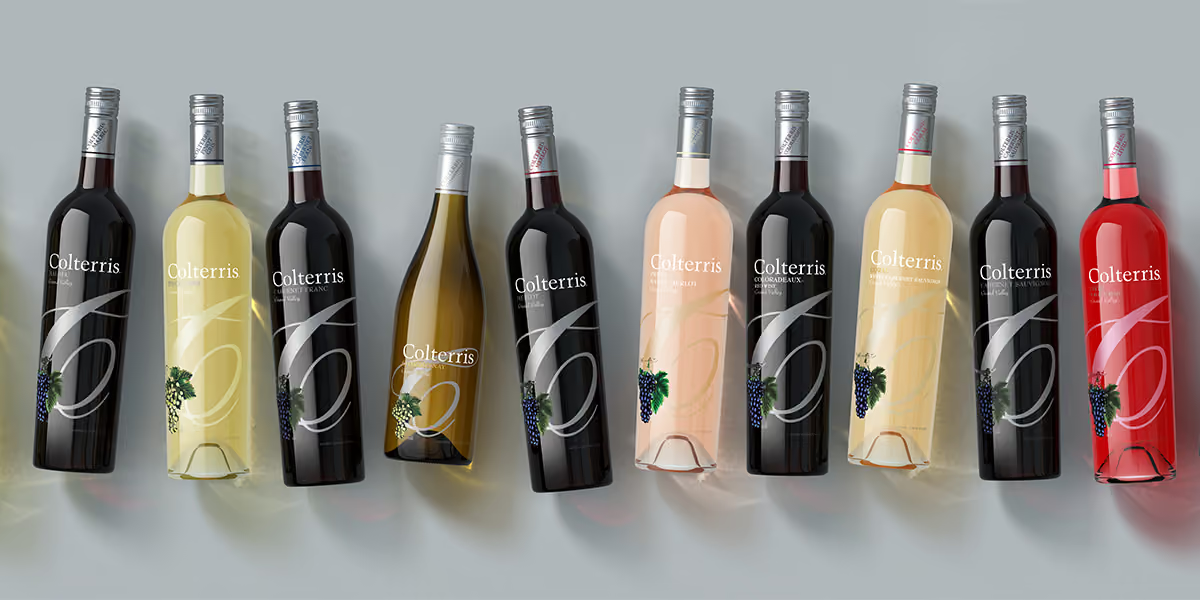
Where the term comes from
Strategy literature has used "execution gap" for decades to name the space between a plan and its delivery. The idea is old. What is new is where it shows up.
This page defines the term where beverage brands feel it most concretely: the visual layer of commerce. On a product page, a sell sheet, or a distributor portal, the gap between knowing and doing is visible to every buyer, and it can be measured.
How to know if you have one
The execution gap is self-diagnosable. These symptoms come from years of conversations with beverage producers, and every one of them is common.
- Last vintage's image is still live months after the new one shipped.
- A marketplace listing is running with a placeholder, or no image at all.
- A distributor deck went out late because the imagery was not ready.
- Phone photos or AI fills are mixed into an otherwise professional library.
- The magnum and the gift pack, often your highest-margin SKUs, are text-only line items.
- Nobody owns the image calendar. Imagery happens when someone notices it is missing.
One of these is a bad week. Three or more is a pattern, and the pattern has a name.
What the gap costs
The 2026 SVB State of the U.S. Wine Industry Report puts numbers on execution. In SVB's peer group analysis, the top quartile of wineries grew sales 8.0% in 2025, the only group with positive average growth. The bottom quartile declined 10.2%.
SVB's explanation is behavioral, not macro. In the report's own words: "success today is behavioral" and "Execution will define success more than macro trends." Top performers share clear positioning, disciplined pricing, and a digital presence that is additive to the consumer experience rather than sporadic.
SVB is describing execution across the whole business. The imagery layer is our argument, not theirs: visuals are where execution is most visible to a buyer, and most measurable by a brand.
The buyer's side of the ledger is just as blunt. In Salsify's 2025 Consumer Research report, a survey of 1,910 US and UK shoppers conducted in October 2024, 54% said they had abandoned a purchase because product content was inconsistent from one channel to the next.
Inconsistency does not read as a small flaw. It reads as a reason not to buy.
How to close it
Closing the execution gap is a process question before it is a budget question. Three moves do most of the work, and none of them require new headcount.
Give the calendar an owner. Most brands have systems for production, compliance, and distribution, and no system at all for imagery. One named owner, one list of every SKU and channel, one check per release cycle.
Set one visual standard. Every image in the library should look like it belongs to the same brand: same lighting logic, same framing conventions, same quality bar. A standard also settles the tempting shortcuts, because a phone photo or an AI fill that breaks it is easy to spot and easy to decline.
Make updates cheap. The gap usually reopens at update time: a vintage change, a label tweak, a new format. Whatever production method you choose, it should treat an update as an update, not as a full reshoot.
Brands that hold these three habits stop scrambling. Imagery becomes a system, not a recurring emergency.
Where Outshinery fits
Outshinery closes the execution gap at the production layer. Studio builds a photorealistic digital twin of your packaging, crafted by trained 3D artists, so a vintage update is a fraction of the original order and your imagery can be ready before your wine even exists. Lite does a narrower job for wine, cider, and beer bottles: upload a label, get a photorealistic bottle shot back in about an hour, self-serve.
The gap stops being rhetoric when it has a score. The Visual Scorecard is a free self-assessment, 27 questions across six dimensions, that places your catalog in one of four states and estimates what rework is currently costing you.
Frequently asked questions
What is the execution gap in beverage marketing?
The execution gap is the distance between knowing what good product imagery looks like and producing it consistently at the pace your channels demand. Most beverage brands know the standard. Far fewer can hold it across every SKU, vintage, and channel.
Is this the same as the strategy-execution gap in management?
It is the same underlying idea applied to one layer of the business. Management literature uses the term for the distance between plan and delivery in general. In beverage marketing, the gap shows up most visibly in the imagery layer, which is why it can be diagnosed and scored there.
Is the execution gap a budget problem?
Usually not. It is most often a process vacuum: no owner, no calendar, no single visual standard. Brands with large budgets carry execution gaps too, they just carry them across more SKUs.
How is the execution gap different from the Rework Tax?
The Rework Tax is the money and time a brand loses redoing imagery that was not right the first time. The execution gap is the wider condition that makes rework feel normal. The tax is a symptom. The gap is the cause.
How do I measure my execution gap?
Start with the symptoms checklist on this page, then take the free Visual Scorecard. It scores 27 questions across six dimensions and places your catalog in one of four states, from paying the Rework Tax to owning your release calendar.