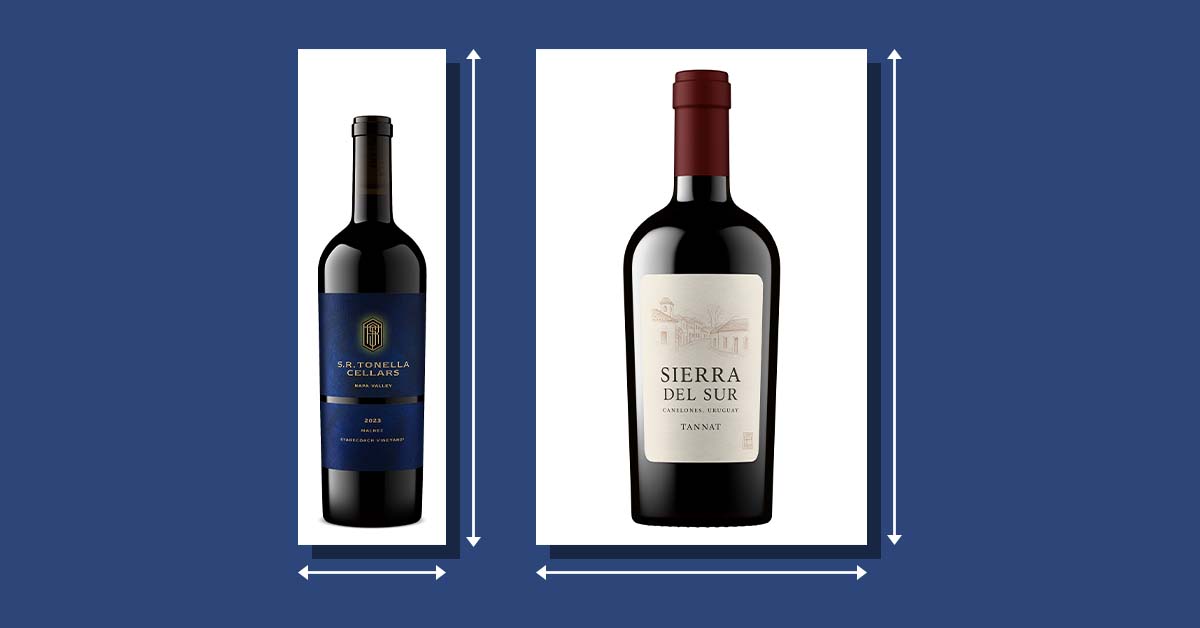
When your portfolio has multiple brands and no shared visual standard
Different agencies, different settings, no shared standard. Here is what closing that gap looks like across a wine group.


Large wine groups know what inconsistency looks like on paper. Different price tiers, different target consumers, different winemaking philosophies. That kind of variation is intentional.
Visual inconsistency is different. It is not a strategy. It is what happens when five brands get managed by five agencies, five photographers, five briefs, and no shared standard between them.
The result shows up everywhere. A flagship label shot with dramatic studio lighting, a budget tier photographed on a warehouse table, a mid-range brand running assets from two vintages ago because nobody had time to redo them before the retailer deadline.
The brands are meant to be different. The visual quality gap is not supposed to be this wide.
The operational reality behind the gap
Most large portfolios grew through acquisition. Brands arrived with existing agency relationships, existing assets, existing ways of doing things. The parent company inherits all of it.
Standardizing across those relationships is hard, time-consuming, and politically complicated when the agencies involved have worked with those brands for years.
So imagery gets managed brand by brand. Each team handles its own shoot schedules, its own briefs, its own retouching. The parent company has visibility into the output but limited control over the process.
When a retailer needs updated assets for a planogram reset, whoever delivers fastest wins. Consistency is the last thing on anyone's mind.
The problem compounds. Vintage rotations mean images should be refreshed every year. Some brands keep up, others run two-year-old imagery because nobody had the bandwidth to schedule a shoot.
Because the shoots are disconnected, the new images for one brand look nothing like the updated images for another, even when both sit in the same tier on the same shelf. This is not a design problem. It is an operational one.

What retailers and distributors see
Category managers at major retailers receive thousands of product submissions a year. The quality of the imagery is a signal.
It tells them how seriously a supplier treats the brand, how ready the product is for the shelf, and whether the assets will work when the product goes live on their site.
The DTC shelf compounds it. Wine groups running their own ecommerce have products displayed side by side. When quality varies between labels from the same company, the weaker images drag down the perceived value of everything around them.
Press kits are the third exposure point. A media kit where the imagery is coherent across five brands looks like an organization that knows what it is doing. One that looks sourced from five different decades reads that way in the coverage too.
The cost of inconsistency is not one bad image. It is the cumulative signal across every touchpoint where your portfolio is seen as a group.
What a structured visual system looks like
The alternative to the brand-by-brand scramble is building visual production into the portfolio operating model. Ste. Michelle Wine Estates understood this.
Managing labels across multiple varieties, price points, and sub-brands, they needed a system that could produce imagery at volume without sacrificing quality or consistency. The standard had to hold from flagship to everyday.
That is the shift worth making: from imagery as a project to imagery as infrastructure.

Every brand gets a defined standard
Not the same aesthetic, because the brands are different. But the same level of care, the same technical quality, the same consistency across vintages and SKUs.
The standard is set once. It travels with the brand.
Production becomes predictable
When a new vintage rolls out, the process is not figuring out who is doing the shoot this year. It is simple: submit the updated label file, receive the updated image.
No scheduling. No shipping physical samples. No waiting on a photographer's calendar. The images can be produced before the wine is in the bottle, so sales sheets and retail submissions are ready the moment they are needed.

Volume stops being the obstacle
A group managing 50 active SKUs across five brands can refresh all of them on a defined cycle. The brand with 4 SKUs and the brand with 20 get the same discipline.
Not every brand in a portfolio has the same visual production needs. That is a feature, not a complication. Outshinery is built to handle the full range.
One system across the full portfolio
Both products run on the same 3D foundations, so the consistency of output is built in. A portfolio using both gets a visual standard that holds across price tiers, not just within them.
Outshinery Studio
For flagship and complex packaging. A specialist builds every image to exact specs: custom glass, foil, embossing, unusual closures. Revisions are included, and work starts within 3 business days.
- Best for premium and complex labels
- A trained 3D artist on every image
- Handles foil, embossing, wax, custom glass, and unusual closures
- Priced in Shine Credits, with subscription plans for groups ordering at volume

Outshinery Lite
For high-volume and standard tiers. Self-serve bottle shots: upload your label, select your bottle and closure, get a photorealistic image in under an hour.
- Best for standard wine bottles at volume
- Automated, self-serve, built on Studio's 3D expertise
- A photorealistic image in under an hour
- $29 per image, dropping to $23 after the first ten orders

Most enterprise groups use both, routing each SKU to the right product based on packaging complexity and brand tier.
Alison Sloga, Creative Director at Mark Anthony Group, describes what the Studio process captures: “Every little detail we specify is captured, bottle shapes, wine colour, light sources, reflections, punt style, fill line. Then the mastery of the label and closure applications with every nuance incorporated, stock, texture, lighting, embossing/debossing, foils, varnishes.”
What the inconsistency actually costs
Outshinery has produced imagery for more than 2,000 beverage brands, many of them large producers juggling multiple labels, agencies, and timelines. The pattern repeats: in a portfolio, the weakest visual standard sets the floor for how the whole group is perceived.
Put numbers on it. Take a group with five brands and 40 active SKUs, refreshed each vintage.
The brand-by-brand way: each SKU gets shot, reshot, and retouched on its own schedule. At a conservative $150 per SKU once you fold in sample shipping and retouching, that is roughly $6,000 a year, repeated every vintage.
And there is no guarantee the five brands end up looking like they belong to the same company.
The structured way: the container model for each label is built once. After that, a new vintage is a label file in and a finished image out. The first cycle builds the library, and every cycle after that the per-SKU cost drops because the model already exists.
The bigger number never shows up on the invoice. On a DTC shelf, the weakest image sets the perceived value of every label beside it.
A tenth of a point of conversion, 2.0% to 2.1%, is a 5% relative lift. On a $1M DTC program that is about $50,000 a year from one change, holding everything else steady.
These figures are illustrative, not a quote. The point holds either way: the brands in your portfolio are meant to be different, and what it costs you when their imagery is different by accident is not.
The brands that stand out across a portfolio are not the ones spending the most on photography. They are the ones with a system behind the images.

Common questions from enterprise teams
Can you handle brands with very different aesthetics?
Yes. The system is not about making brands look the same. Each label is built to its own specs: glass shape, closure, label finishes, and lighting direction.
What stays consistent is the production process and the quality bar, not the visual identity. A premium Napa Cabernet and an everyday Central Valley Chardonnay can both come from the same system without either looking like the other.
Is a portfolio of hundreds of SKUs workable?
Yes, large portfolios are the primary use case. Studio handles complex or premium labels with a specialist on each image, and Lite handles high-volume standard formats at self-serve speed.
The container models built for each brand carry forward vintage to vintage, so the per-SKU cost drops significantly after the first run.
How does onboarding work for a multi-brand group?
Enterprise onboarding starts with a scoping conversation to map your portfolio, identify which brands need Studio versus Lite, and agree on the visual spec for each.
From there, your team submits label files and packaging specs brand by brand, and Outshinery builds the container models. Once a brand's model is in the system, all future vintage updates and SKU additions are submitted against it. There is no starting from zero each cycle.
Do we need to ship bottles or samples?
No. The inputs are a print-ready label file and your packaging specs: glass shape, closure type, capsule finish, and any label embellishments. No physical samples are required at any stage.
Because the imagery is produced without shipping physical samples, it also works for vintages that have not been bottled yet, so sales materials can be ready before the product exists in finished form.
How does pricing work across a portfolio?
Studio runs on Shine Credits, with subscription plans for groups ordering at volume. Lite is priced per image. Most enterprise groups use a combination: Studio subscriptions for flagship and complex labels, Lite for high-volume standard formats.
The Outshinery team can build a custom estimate based on your SKU count and production cadence.