How to get bottle shots before your wine is bottled
Why wineries that schedule imagery from a label file run weeks ahead of their release calendar.


Most wineries treat product photography the way they treat shipping: it can only happen once the wine exists. Label is approved. Glass is filled. Capsules are crimped. Cases land at the loading dock. Only then does someone schedule a wine bottle photographer, package fragile bottles, and wait for proofs.
That sequence used to be the only one available. It is not the only one anymore.
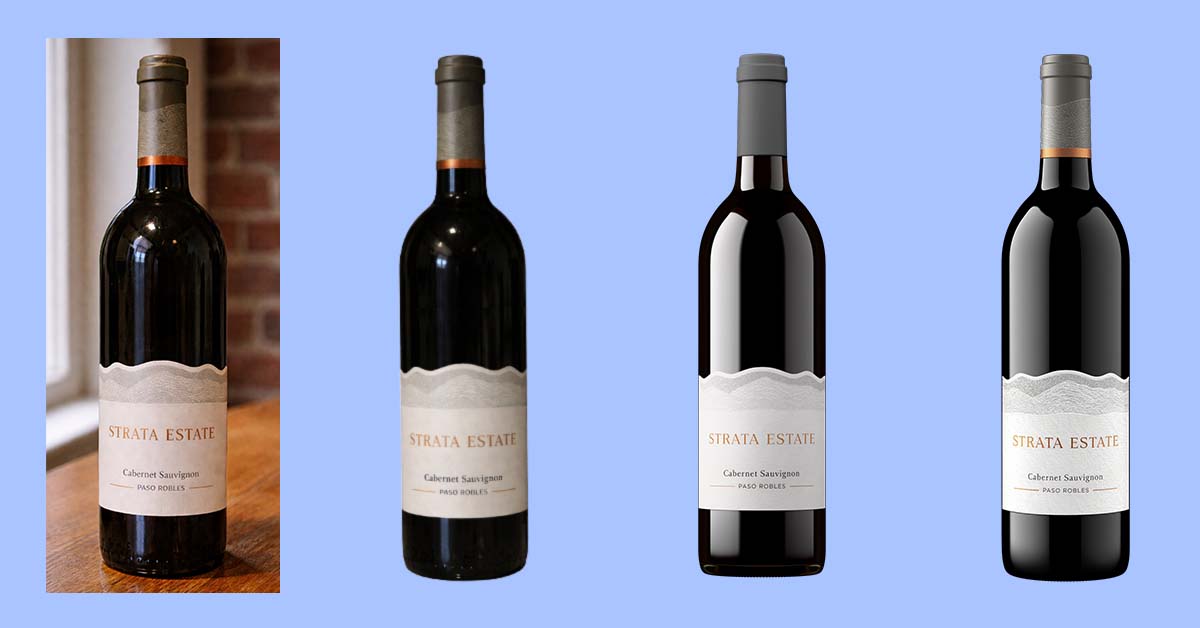
The label file and the container spec are the only inputs needed to produce a photorealistic image of the finished bottle. Both exist weeks, sometimes months, before the wine is bottled.
If you are finalizing your wine label design, the bottle shot is the next step in your launch sequence, not a separate project months later.
A winery that recognizes this turns photography into a label-file trigger instead of a bottling-day trigger. It runs its entire pre-release marketing calendar from that earlier start line.
This is a timing argument, not a price argument. The traditional shoot still produces beautiful work. But the moment of capture is no longer the only place quality lives.
The hidden cost of waiting
Between label approval and bottling, a winery quietly forfeits a series of revenue and visibility opportunities.
Pre-sale and pre-order campaigns cannot launch without product imagery. Distributor sell sheets go out with placeholder graphics or get delayed.
DTC collection pages stay empty or run last season's shots. Press pitches for fall release coverage land in journalists' inboxes without a bottle image, which most editors flag as a no-image, no-feature signal.
Wine clubs feel this most acutely. The release email needs imagery before the wine ships. Members open the email, see the upcoming selection, and either buy or skip.
A blurry advance photo or a recycled shot from the prior vintage gives the club member nothing to react to.
None of this is dramatic. No single missed shot kills a release.
The cost shows up in the aggregate: a fall release that planted its flag in late August instead of late June, a distributor presentation that compared poorly to a competitor with cleaner assets, a wine club open rate two points below the prior cycle. This is the part of the year a winery never gets back.

The traditional photography timeline
A traditional product shoot for a single vintage release rarely takes less than four weeks end to end. The breakdown:
- Wine produced and bottled (the start trigger)
- Labeled bottles set aside and packed for shipping (1 to 2 days)
- Shipping to the photographer (3 to 7 days, longer with alcohol shipping compliance)
- Studio coordination and shoot day (1 to 2 weeks of calendar time, depending on availability)
- Retouching and final delivery (1 to 3 weeks)
For a small producer using a local photographer with no shipping required, the timeline compresses but rarely below two weeks. For brands sending samples across state lines, every step gets longer.
Alcohol shipping regulations require licensing in most U.S. states, which restricts the photographer pool to local options or forces expensive workarounds.
Reshoots add another full cycle. A label color that prints differently than the digital proof, a capsule that wrinkles on the line, a fill line that came in lower than expected, any of these triggers a second round.
Reshooting an existing SKU costs roughly the same as the original session, because the camera does not care that the model and lighting were already chosen.
The single bottleneck across every variant of this timeline is the physical bottle itself. The shoot cannot begin until the bottle exists. Imagery cannot move ahead of production.
The CGI timeline from a label file
A computer-generated image of a finished bottle does not require the bottle. It requires three inputs: the final label file (vector, layered, exactly what the printer receives), the container specification (mold reference and dimensions), and the closure details (capsule color and finish, cork type if visible).
Outshinery's Studio production team works from those three inputs to build what we call a digital twin. A trained 3D artist constructs a photorealistic model of the bottle, applies the label with print finish interpretation (foil, embossing, wax, varnish, debossing), and renders the image to marketplace specifications.
Studio orders start within three business days of brief receipt. Typical delivery falls in the two to five business day range, with subscriptions including fast-track.
The bottle does not exist anywhere except inside the render. When the physical wine is bottled weeks later, the imagery is already in distributor decks, on the DTC site, and in the wine club teaser email.

For wineries with a standard bottle, a finalized label file, and no complex print finishes, Outshinery Lite handles the same job a wine bottle photographer would do, in under an hour. Upload the label, select bottle shape and closure, download the PNG.
$29 per image, $23 after the tenth order, marketplace-ready by default.
Neither product requires a physical sample. Neither product requires shipping physical samples. Neither product is waiting on bottling day.
Jordan Tanaka, Tasting Room Manager at Shadow Ranch Vineyard, describes the shift in operational terms: "We can even get shots before we have the wine bottled."
That is the change. The marketing window opens the moment the label is approved, not the moment the wine is ready to ship.

What eight extra weeks unlocks
Move the imagery trigger from bottling to label approval. A number of revenue activities that previously could not happen begin to fit inside the calendar.
Pre-sale campaigns
Pre-sale campaigns become possible. A winery announcing a fall pinot release in late June can collect pre-orders for eight weeks before the wine ships.
The imagery the buyer sees on the pre-order page is the same imagery they will see when the bottle arrives.
Distributor sell-in
Distributor sell-in moves earlier. Distributor reps build their fall portfolio decks in the late summer.
A winery whose new SKU appears with clean, professional imagery in those decks is materially more likely to land shelf placement than one represented by a label-only graphic or a phone snapshot.
Press and trade media pitches
Press and trade media pitching shifts. Editors planning fall coverage need product images in their hands six to ten weeks before publication.
A late-July pitch with a finished bottle render goes into consideration. A late-September pitch with a phone shot does not.
DTC collection pages
DTC collection pages launch ahead of stock arrival. The product detail page lives, accrues SEO authority, and primes the audience.
When inventory arrives, the listing converts immediately instead of building from zero.
Wine club teaser emails
Wine club teaser emails open the cycle. Members get a first look two weeks before allocation, with imagery that does the wine justice.
Open rates and click-through on club emails are sensitive to imagery quality. Better images generate more pre-shipment engagement and reduce post-shipment surprise.
None of these are speculative gains. Every winery already plans these activities.
The question is whether they can execute them in the window when the marketing return is highest, or whether they wait for bottling day and accept whatever window remains.
Studio or Lite for your pre-release shot
The two products handle pre-release imagery differently. Routing the request correctly determines whether the output matches the wine.
When Studio is the right call
Studio is the right call when the packaging carries any complexity. Foil stamping, embossing, debossing, textured papers, custom capsule branding, applied ceramic labelling (ACL), and proprietary bottle shapes all require a trained artist to interpret the production file.
Studio also produces every output beyond a flat product shot: lifestyle imagery, beauty shots, recipe pairings, video, POS displays, gift boxes, shippers, and case stacks. A premium fall release that needs a full launch asset set lives in Studio.

When Lite is the right call
Lite is the right call for a standard wine bottle with a flat-printed label. Bordeaux, Burgundy, Hock, Sparkling, Port, and dessert wine shapes are all supported across 375mL, 750mL, and magnum sizes, with closures from screwcap and natural cork to wax dip and sparkling hoods.
Eleven glass colors, twenty-four liquid colors, five closure types, seventeen closure finishes. If the label fits on a flat die-cut surface and the print finishes are conventional, Lite renders the same quality output Studio delivers, in under an hour, for $29.

Real routing moments
A few real routing moments to keep in mind. Embossed foil or a debossed label on a Burgundy bottle belongs in Studio, not Lite. A flavored wine with hibiscus tint, a standard screwcap, or a wax-dipped top belongs in Lite.
A spirits bottle, a beer can, or a bag-in-box belongs in Studio. A distributor catalog with twenty SKUs across multiple producers, where source files are inconsistent, usually starts in Lite and routes specific complex labels to Studio.
The decision is about what the packaging requires, not about budget. Lite is not a cheaper version of Studio. It is Studio expertise, automated and scoped to standard wine bottles.
A real scenario: imagery before bottling day
A West Coast winery is planning a fall release. The new vintage chardonnay is bottled in late August. The release calendar is locked by mid-June.
The distributor pitch happens in late July. The wine club allocation goes out in early September. First shipments arrive at retail in late September.
The traditional sequence
In the traditional sequence, the chardonnay gets photographed in early September, after bottling, with imagery delivered to the marketing team by mid-to-late September.
That delivery date is two days before the wine club email needs to send, and one week after the distributor deck was due.
The digital twin sequence
In the digital twin sequence, the same chardonnay label file is approved in early May. The Studio brief goes in immediately.
The digital twin and final render are delivered by mid-May. The marketing team has imagery in hand four months before bottling.
The distributor deck for late July includes a clean front shot, a back shot, and a labeled bottle on a clean background. The wine club teaser email goes out in late August with the same imagery.
Pre-sale opens on the DTC site at the start of September. By the time bottling happens, the chardonnay has been visible to the audience for three months and has built measurable demand.
The math is straightforward. One Studio render plus one back-shot order, charged in Shine Credits, replaces a multi-thousand-dollar photographer session and shifts the marketing calendar four months earlier.
This is what bottle shots before release date actually look like in practice. The wine is the same wine. The window is what changed.

What to send Outshinery to start
The label file is the trigger. Once the label is locked, a Studio brief can move into production. Three inputs make the brief clean.
The label file
The label file itself, in vector format, with all layers intact and print finish indicators clearly marked. The same file the winery sends to the printer is the right file. JPGs, PNGs, flattened PDFs, and screenshots cannot capture foil, embossing, or varnish. Vector or layered PDF, every time.
The container specification
The container specification. This is the most common friction point in pre-release briefs. Small wineries often know roughly what their bottle is (a Bordeaux, a Burgundy) but not the exact mold reference. The mold reference lives with the bottle supplier. A call to the supplier, or a quick check of the original packaging order, surfaces it.
The closure detail
The closure detail. Capsule color and finish (gloss, matte, metallic, embossed), cork type if visible above the bottle, screwcap color if applicable. The supplier knows the spec exactly. A finished-bottle reference photo helps if the closure has unusual branding.
For Lite, the inputs simplify
For Lite, the inputs simplify. A high-resolution label file (raster is fine for Lite), bottle shape from the library, glass color, liquid color, and closure type.
No vector file required. No mold reference required.
The earlier in the production cycle these inputs are gathered, the earlier the imagery moves. A label approved in May with a Studio brief submitted the same week has imagery in hand before June begins.
Bottling day no longer needs to set the marketing calendar. The wine still needs to ferment, age, fine, and finish on its own clock. The imagery does not.
Outshinery exists for this gap. Studio for human-crafted renders across every container type, every print finish, every brand content need.
Lite for standard wine bottle shots in under an hour, $29 per image. Both work from a label file and a container spec. Neither needs a physical bottle.
The wineries already running their release calendars from label approval instead of bottling day are not doing anything unusual. They are using the only production method that can give them the imagery before the wine is ready to ship. Everyone else is waiting.

Frequently asked questions
Can you get bottle shots before the wine is bottled?
Yes. Outshinery Studio works from a vector label file and a container specification to produce a photorealistic render of the finished bottle. The physical bottle does not need to exist.
Studio orders start within three business days of a complete brief and typically deliver in two to five business days. Outshinery Lite produces standard wine bottle shots from a label file in under an hour for $29 per image.
What files do I need to start a pre-release order?
For Studio, the same label file you send to your printer: vector format, with all layers intact, and foil and embossing indicators clearly marked. Add the container specification (mold reference) and closure details (capsule color, cork visibility, screwcap finish if applicable).
For Lite, a high-resolution flat label file plus bottle shape, glass color, liquid color, and closure type from the library.
How early can I order bottle shots for a fall release?
Once the label file is locked, the order can move. Many wineries lock labels three to four months before bottling, which means wine product photography can be delivered up to four months ahead of the wine being physically ready.
The marketing window opens the moment the label is approved, not when the bottle is filled.
Does Outshinery photograph the actual bottle?
No. Outshinery works as a virtual studio, building a digital twin of the bottle from production files and rendering the image without a photoshoot.
Studio's 3D artists interpret foil, embossing, wax, and varnish from print specifications. Lite's automated pipeline does the same for standard wine bottle configurations.
How does pre-release imagery affect distributor sell-in?
A distributor evaluating a new SKU during pitch season is making snap brand-quality judgments based partly on the imagery in the producer's sell sheet. Clean, professional product shots in hand at pitch time materially improve the odds of placement.
Wineries that wait until bottling to commission photography often miss the late-summer distributor pitch window for fall releases entirely.
Pre-release bottle shot checklist
Before you send your order, confirm:
- Label file finalized. Vector or layered PDF with print finish indicators for Studio. High-resolution raster is fine for Lite.
- Container spec confirmed. Exact mold reference from your bottle supplier for Studio. Shape from the library for Lite.
- Closure detail confirmed. Capsule color and finish, cork type if visible, screwcap finish if applicable.
- Front-only or front-and-back decided. Back labels are a separate order.
- Target delivery set against your release calendar, not your bottling date.